Tuesday, July 13, 2010

Happier When -- Maybe

Leaving the calm and remote RV camping at Shelton Elks:


Arrived at Roamers Rest south of Portland and parked cheek to jowl.


Why you ask. It is the nature of human condition to anticipate happier times "if something". For me it was warmer weather. My preference for day time temperatures at 80 degrees plus or minus five degrees was not going to be met by my original destination RV camping along the Pacific Ocean. My conclusion is that I am a sunny southwest person. (Note to self: southwest's Four Corners in summer 2011.)

Abandoning plans along the Pacific coast, I have arrived at Portland about three weeks earlier than my original intent. This early arrival will give me plenty of opportunity for exploring -- Portland, its suburbs, the nearby Columbia River, the Willamette Valley, long day trips, etc. And find a dental hygienist and dentist for an annual checkup. After this extended stay, I will be ready to resume nomadic travel.

Sunday, July 11, 2010

Book: Ghost Train to the Eastern Star by Paul Theroux

"Travel is fatal to prejudice, bigotry, and narrow-mindedness." - Mark Twain

"Perhaps travel cannot prevent bigotry, but by demonstrating that all peoples cry, laugh, eat, worry, and die, it can introduce the idea that if we try and understand each other, we may even become friends." - Maya Angelou


Ghost Train to the Eastern Star is an account as Theroux in his late sixties reprises his train travels of his book Great Railway Bazaar -- thirty years earlier. This current book begins:
"...So many travelers are hurrying to the airport, to be interrogated and frisked and their luggage searched for bombs. They would be better off on a national railway, probably the best way of getting a glimpse of how people actually live -- the backyards, the barns, the hovels the side roads and slums, the telling facts of village life, the misery that airplanes fly over. Yes, the train takes more time..."
Since Theroux's original 1975 train journey, the USSR and its puppet states are no more, Iran has closed its borders and the southeast Asian countries are a "new" world. His earlier journey was in the early months of 1975 as the Vietnam War came to end in April. In his current travels, he converses with those who lived through the past 30 years comparing their lives -- then and now. Experiencing a world on trains allows lots of time to chat with his fellow passengers.

Every travel writer will have biases as his story is brought forth. That is why I read travel books from many different authors. Each will have a different approach to the travel and how they travel. Younger travel writers versus the older travel writer each will address the issues and present them in different ways. With this diverse reading from several authors, it is a vicarious experience to address my curiosity and broadening of my understanding the world. I am thankful that these writers do make that travel and report back with their experiences.

The last paragraph of the book summarizes the author's thoughts of this train journey across Europe and Asia:
"... Most people on earth are poor. Most places are blighted and nothing will stop the blight getting worse. Travel gives you glimpses of the past and the future, your own and other people’s. ... [T]here are too many people and an enormous number of them spend their hungry days thinking about America as the Mother Ship. I could be a happy Thai, but there is no life on earth that I am less suited to living than that of an Indian, rich or poor. Most of the world is worsening, shrinking to a ball of bungled desolation. Only the old can really see how gracelessly the world is aging and all that we have lost. Politicians are always inferior to their citizens. No one on earth is well governed. Is there hope? Yes. Most people I’d met, in chance encounters, were strangers who helped me on my way. ..."
Many times as I read through the book, it could get seriously depressing as Theroux related the oppression of some peoples, the sex slavery, the starving masses, etc. As a good reporter, he related what he saw.

Theroux's view is not what Americans see on TV. When world leaders meet in that foreign country, they meet in some luxurious surroundings at the end of the red carpet after arriving in the black limos. The cameras may pan over the slums and the poor that survive in those cities. However, more TV time is spent showing the world leaders in photo ops. The impression left is that all is good in that remote country.

Saturday, July 10, 2010

Tiffany Studios Museum

Washington's Capitol building was completed in 1928. The building is of classical design with extensive use of local sandstone, marble from Alaska and Europe.


Tiffany Studios Museum? Not really. However, the Washington State Capitol has fixtures and chandeliers throughout the building that were designed and made by Tiffany Studios of New York. The largest creation is the five ton chandelier suspended from the dome.


In this earthquake prone region, I hope the building is strong and stable enough to keep that chandelier up there. Regardless, I wouldn't like being in this building during a tremor.

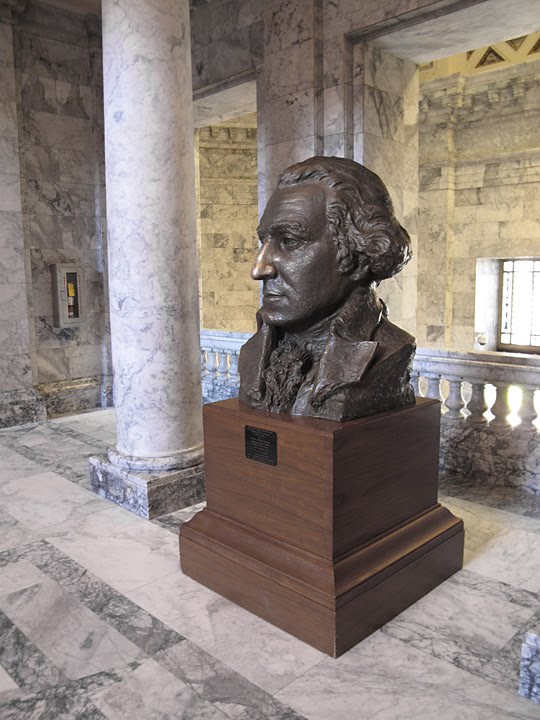
After the tour, I wandered around the building taking more photos and admiring the building design and stone work. That was when I came upon the state's name sake -- George Washington. This sculpture was not on the tour. Regardless. It must be getting lots of visits considering George's shiny nose.


The tour guide provided all those tidbits of information that are typically shared with a tour group. When speaking of the height of the capitol building, I believe she said is was the fourth tallest in the country. So which state had the tallest. The trivia: Louisiana at Baton Rouge has the tallest capitol building.

Friday, July 9, 2010

Elks and Moose

Not those animals. But the fraternal organizations by the name.

A privilege of Elks membership is to park at the RV spaces that are provided at some of the Elks Lodges across the country. I've used them many times in my travels and frequently when in Denver or San Diego.

When I arrived at the Shelton WA Elks Lodge, the signs at the entrance indicated that this was the location for both the Elks and Moose Lodges. A first and -- indeed -- a surprise.


Checking the rules and regulations board, the campground is for the use of Elks members. Two of the spaces appear to be occupied "permanently". One other transient besides myself in the 20 spaces.

The two level building has a walk-out downstairs. The main level upstairs is the Elks. The downstairs is the Moose and the entry is at the rear of the building.

The situation is symptomatic of Elks and Moose Lodges across the country. Memberships are declining. How to keep the Lodges going. The average member age of most Lodges is over 65. This site appears to have been the Elks first. At some point it appears the local Moose needed new space and the Elks leased the lower level to the Moose.

No activity at either bar for my first two nights here. Perhaps there will be some activity at the bar of one of these lodges this weekend for me to get the full story. Without a Moose membership, I may never get the story.

Wednesday, July 7, 2010

Book: Reinventing Collapse by Dmitry Orlov

Living in Russia before and after the collapse of the Soviet Union, the author compares the super power that failed and the super power that survived -- so far. The author describes the scenario of possible collapse of the US. It is not a pleasant view. His personal view of Russia after the collapse are the details of what life was like behind the headlines. Orlov looks at the United States and sees a population that would be ill prepared economically, emotionally and physically for a similar economic collapse.

Assuming there is a peak oil point, it is the downward side of that slope that is described in the book. The reader may not agree with the author on his scenario or possible adaptations in that event, but the worth of the book is drawing attention to how we live and who we are.

As the author described the world after economic and political collapse, I find that I am prepared for that future as a nomad living in a small home on wheels. Bring it on!

Tuesday, July 6, 2010

Verizon Air Card

Some days are better than others. That also goes for the throughput on the Verizon air card. When I arrived at the Elks Lodge in Port Townsend, there was good signal with three bars showing. Sometimes it was four bars. My internet searches were speedy and downloads were what was expected of broad band.

On Saturday morning of the Fourth of July weekend, throughput was gone with one bar and sometimes none. Occasionally, the air card accessed the internet via National Access. It was the dark ages. Considering the slower than usual broadband throughput, I concluded that Verizon must have gone to their backup power source -- wind.


Now that the holiday weekend is past, the throughput is back to what it was last Friday. It does make one wonder. 

Considering this was a three day weekend, my suspicions were that Verizon sold lots of band width for the weekend to some large corporation to move billions of bytes of data from one data center to another. That along with a couple of Lear jets would have been used to move data from one data center to another. Considering the spate of recent bank failures, could that be a possibility.

Or is it a conspiracy theory.

Postscript on Tuesday morning: As stated above, throughput was great. This morning not so good. Bad in fact. Back to wind power.

Monday, July 5, 2010

Whale Watch

Whales have their life. If they don't feel like playing, they don't. They do whatever they want. How about some spirals and splashes. Nope. They aren't getting paid to perform. They were searching for their lunch of salmon. That according to the on board naturalist.


This wasn't the first time for a whale watch. Humpbacks were the previous whale watches -- off Hawaii's Maui coast. This time it was the orcas in the waters off Anacortes, WA. There were times we were closer to Canada than the US. (No shots were fired to protect their borders.)

I didn't have high expectations to see whales doing flips, flops and rolls. And I wasn't disappointed. My conclusion. No more whale watches. On a Maui whale viewing years ago I saw a great show by the whales. There is no reason the experience could ever be repeated.

So if I want to see whales perform, the next time I will head to Sea World in San Diego. However, that won't happen.

Sunday, July 4, 2010

Book: Jack London -- A Biography by Daniel Dyer

The biography describes a very charismatic, focused, and adventure seeking London. In a short life of 41 years, London accomplished what borders on a story plot for a novel. From a disadvantaged dysfunctional childhood and an eighth grade education, London worked as a boat deckhand, explored for gold in the Klondike, toured the Pacific on a sail boat, went on speaking tours, developed a working cattle ranch and in his spare time wrote extensively including fiction that has not been out of print for 100 years.

Don't want to read a whole book.... Wikipedia provides a good abbreviated bio of Jack London.

Friday, July 2, 2010

Walking Port Townsend

Several buildings along the water front main drag of Port Townsend date to the Victorian era. Some are in need of work. Others have been upgraded to condos like this one.


Many of the building exterior walls advertised the building commercial interests or in this case the ad was for Bull Durham tobacco. Nothing small about this ad. It covers the entire side of the building from the sidewalk to the alley.


Continuing my walk, this 1957 Chevy was spotted. I always liked the lines of that car. My grandfather bought a new 1957 Chevy sedan after driving Dodge products for many years.


After a great lunch at a Thai restaurant downtown, I headed over to this retro fifties soda fountain for an ice cream treat. That was the last food for the day. The pants were getting a bit tight.


More walking to work off lunch and ice cream was when I met Lydia and Ray in front of Waterfront Pizza (the best in town). Lydia and Ray are traveling on the tandem bicycle from Calgary to San Francisco. No. They are not pedaling back to Calgary. They are getting on a plane for the return trip. Their travel companions, Marty and Barb, stopped by momentarily as they headed back to the laundry. 


Ray and Lydia had tried to do the same journey last year, but were hit by a drunk driver 20 days into their travels. Although both were scratched up pretty badly, nothing was broken -- beyond the bicycle. After a day or two in the hospital they returned to Calgary to heal and plan for a future ride. 

Considering last year's trauma, the couple was quite up beat about life and this journey. With the rush at Waterfront Pizza, Ray and Lydia had to wait for the next cycle of pizzas from the oven. That gave us plenty of time to chat about travel. Regarding tandem bicycle riding, Ray joked that it helps when somebody needs to read the map and act as navigator. 

Thursday, July 1, 2010

Running away???

Grounded  a book written by Seth Stevenson. Subtitled "A Down to Earth Journey Around the World".

The intent of Stevenson and his wife was to travel around the world without using air travel. Several forms of transportation are used in this circling of the earth and each leg is planned as the previous leg is completed. The descriptions of the traveling accommodations and his fellow travelers makes the book. However, the travel is mostly moving with almost no local exploring before boarding the next leg of travel around the world. I may have missed the author's self imposed deadline for the trip's completion. It seems he may have been rushing the journey.

Perhaps that is the reason for the author making this observation when the journey isn't half over: "The wonderful thing about extended travel—the whole lifestyle, with the come-and-go friendships and the rootless freedom—is that it breaks you out of ruts you’ve carved in your everyday life. But when you never stop traveling, travel itself becomes a rut. At some point, you’re no longer gaining a richer perspective on your life. It’s more like you’re running away." (Italics my emphasis.)

Perhaps my nine year nomadic travel is running away. However, for me it is running from all the "prescribed shoulds and needs" that were drummed into my brain in my youth and beyond as a victim of the American corporate culture and an unending dose of advertising messages. Deprogramming takes a long time.

For me, my nomadic travel is "running to" satisfy my curiosity: to see the natural beauty of the land; chat with the peoples that inhabit much of the North America; taste the variety of ethnic foods; explore the farmers markets; my Wisconsin farm roots causes me to note farming practices and crops across the country; finding and admiring building architecture in older downtown sections; ... and more. Curiosity results in learning regardless of the source. I also learn from my fellow travelers as well as those who live a settled existence.

At that inevitable time when I give up the nomadic travel, my hope is that I am physically and mentally able to explore the smaller physical world where I have settled. The hope is that I can take up where I left off before I started the travel.... Go to art cinema. An occasional live theater performance. Memberships at the museums, the zoo, the botanic garden for frequent visits. Going for a walk or a hike.  ....and more.

No. My life is not running from something. I am running forward to live each day -- where ever I may be camped or settled.

Time to run...